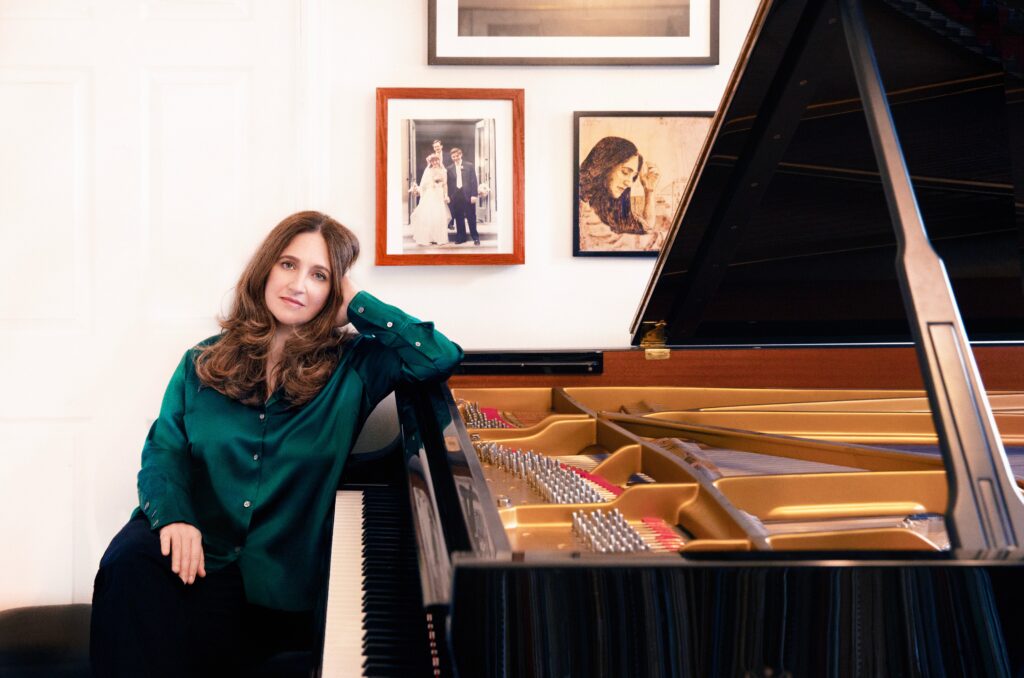
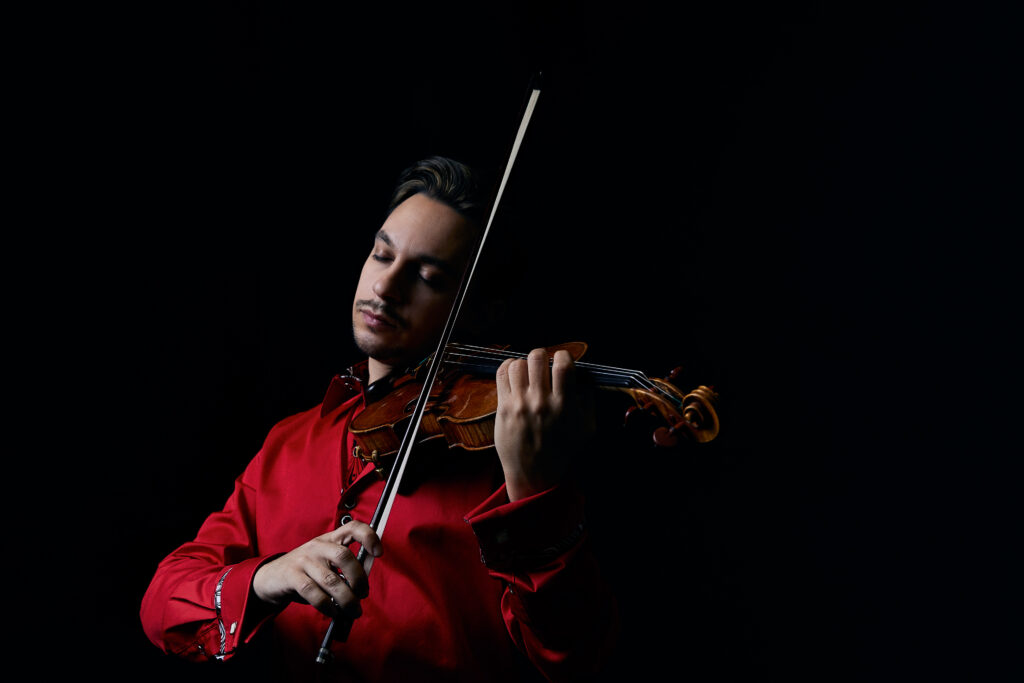
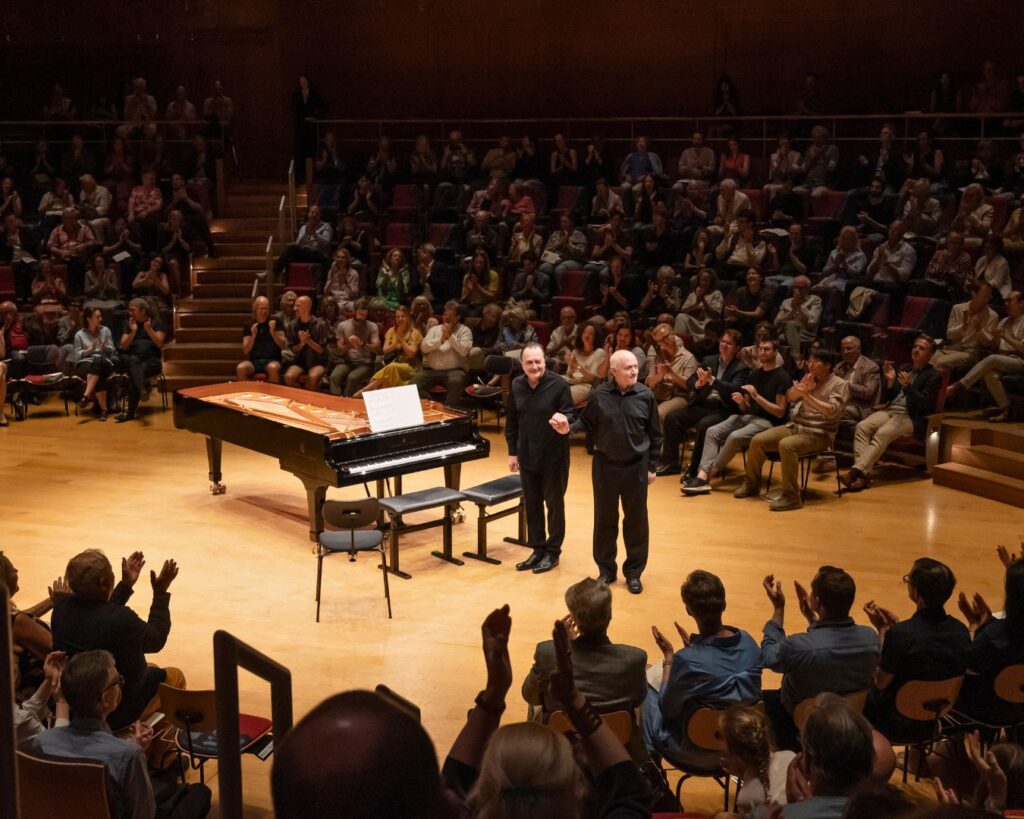
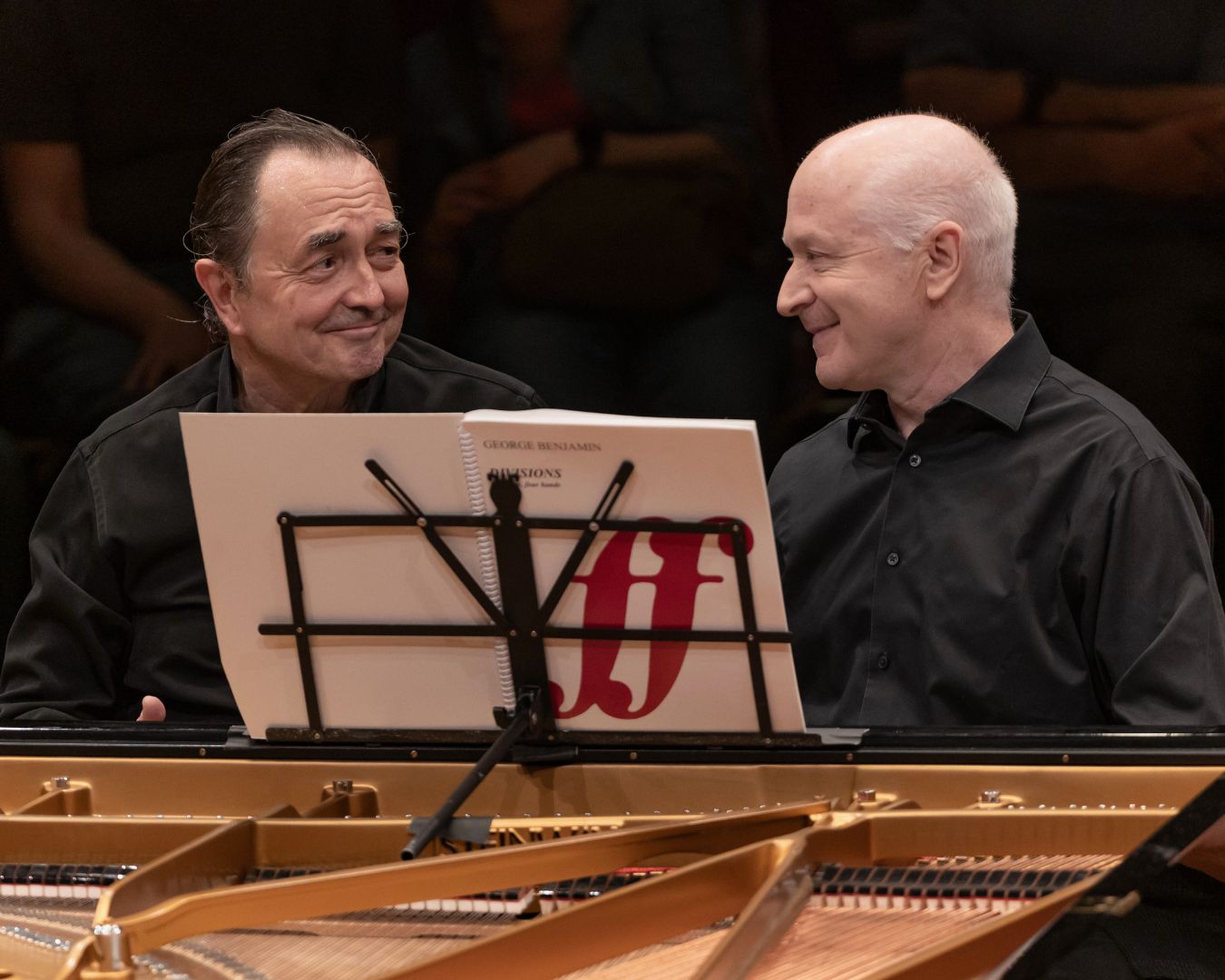
In the second half of our conversation with British composer Sir George Benjamin and French pianist Pierre-Laurent Aimard, the two friends discuss Stravinsky, Schoenberg, musical rivals, and influences.
Stories: Pierre-Laurent Aimard and George Benjamin, Part II
Share: 


PLA:
Here’s something I would ask you. I’m reading the big biography on Schoenberg by Stuckenschmidt. A huge book. It’s very musicological.
GB:
Oh dear, what’s coming. [laughs]
PLA:
I think that I love the person more and more.
GB:
Schoenberg? [gasps]
PLA:
Well, the music anyway.
GB:
Oh, the person is complicated.
PLA:
Extremely complicated. Conflicted. Paranoid. Tortured. Aggressive, very aggressive. In a social tumult, permanently, for nothing.
GB:
I know one sees one side of his character in reading the letters to Berg, which are really disturbing. He frequently treats his pupil with contempt. And really, it’s just horrible that anybody could write to anybody in such terms, let alone Berg who of course was a genius (albeit one virtually created single-handedly by Schoenberg). But then from the other side, when I did the Ojai Festival in 2010, I met Larry Schoenberg, his son, and we had a long conversation about his life as a child. The picture he painted of his father was quite wonderful. That he was a devoted, loving, tender, and morally strong, admirable parent. So, like everybody, there’s a mixture.
PLA:
So passionate. So committed.
GB:
Two years ago, I conducted Chamber Symphony No. 1 for the first time, with my great friends in the Ensemble Modern. I found it immensely difficult. One of the most difficult things I’ve ever had to learn, and very challenging to conduct. But once I got into it (and we had a lot of rehearsal), I adored it. It’s unbelievably satisfying to play, and there’s so much room for interpretation and freedom of expression. Tremendous. It’s formally so alive. I don’t know if I’ve ever enjoyed conducting a piece so much. Ever before.
PLA:
His middle period is an almost constant miracle. It’s hard to imagine music that is more nourishing.
GB:
I really do understand that, having had this experience with that piece. Unbelievably, there’s so much for the performer. He was not a piano composer. He played… was it the cello? He was a person who breathed new life into polyphony at the beginning of the 20th century. I think it really, really is profoundly performers’ music. Written to be heard, of course, but also to be played. The access is in the favor of the performer. I think it’s incredibly rich in terms of phrasing, in terms of polyphony, in terms of action.
PLA:
I find him to be one of the most musical composers ever. I mean, he’s seen as an intellectual, but he’s so naturally musical, especially the middle period.
GB:
Except I have problems with his harmony, even in the Chamber Symphony. I’m so sorry, but… there’s a problem there. Maybe it’s because his music is more emancipated linearly than any other music before it. That aspect is fantastic. In the Chamber Symphony, everybody is all the time playing something interesting, wonderful, pointed, full of character, full of expression, full of air, full of breath. So that’s a marvelous thing. But the harmonic side suffers. And I find his long-term harmonic thinking a little problematic, but that’s my problem.
PLA:
It’s a big question mark in general. I was shocked, almost, by what he said about Pierrot lunaire to one of his singers. That, in fact, in this music, there was so much instrumentalization that one should never listen to the notes, the pitches, but only to the colors. He said that. And I think, “But well, he’s supposed to be the guy who organized the notes properly.” And this explains a lot about his fascination for music of tradition, and also for his interest in other creators. Don’t you think so?
GB:
Without question. He’s a provocative, revolutionary, fascinating figure, one of the most in the history of music. But he’s a problem figure, also. Perhaps in a different time, in 50 years, 250 years, people will find him utterly fascinating, this person who overturned certain aspects of music in such a dramatic way, and whose mind was so unbelievably alive, but who’s a problem composer. Just like problem painters who have mannerisms that were maybe thought to be offensive in their day, but we cherish them for those characteristics now. Someone like El Greco, for instance, was a mannerist who must have seemed so weird in his day. I adore him much more than other, more conventional painters of the late Renaissance. But we’ll see. Certainly, his music isn’t very much played at the moment, is it? Even now, over 100 years later.
PLA:
You know, for the Schoenberg year, I proposed his entire piano production. Which means, 50 minutes, 52 maybe… only good, extremely good pieces and very varied. I arranged it to avoid any kind of problems for any possible presenters, as I tried to do for Boulez. It was the only composer where almost nobody showed interest. Well, one very exceptional person. And I’ve done the project three times, maybe, the entire year.
GB:
Gosh, it’s interesting that the person that brought us together, Messiaen, really disliked his music, didn’t he?
PLA:
Yes, definitely, yes.
“I mean, it’s extraordinary as a form of linear stream of consciousness, that it just never turns back. It just continues to evolve in the freest way possible, and it builds up to an immense climax without percussion in the middle.”
GB:
Really disliked it.
PLA:
Definitely. In Yvonne’s class [Yvonne Loriod, Messiaen’s wife], for instance, Schoenberg didn’t come up. I had a colleague who was an excellent musician and pianist who was crazy about Schoenberg – loved it and played it but couldn’t mention it.
GB:
But Messiaen hugely admired Berg, and Webern was mentioned from time to time.
PLA:
Which Webern then? The early?
GB:
The wonderful, mad crystal Webern. Boulez did a lot of Schoenberg in his life.
PLA:
Oh, a lot. It was a major figure for him.
GB:
Did he love the music?
PLA:
I think that he had very strong admiration for him, and that he has permanently dealt with his music. Of course, he was critical. He did write the famous article, “Schoenberg is Dead.”
GB:
I don’t like that title.
PLA:
It’s terrible. But it was the provocation of public artists at that time when they wanted to be heard. And yes, it was efficient, because we still speak about it.
GB:
Yes, and unfortunately, I fear it has harmed Boulez’s reputation. What about Ligeti and Schoenberg? Also not fond, isn’t that right?
PLA:
I don’t think so. I don’t remember having spoken so much with him about it.
GB:
I remember reading somewhere that he [Ligeti] was very critical [of Schoenberg], that there was too pedantic an attachment to the melodic, the thematic cell in his music, and the fact that it was imitated in a traditional way, he found it too pedantic.
PLA:
But because Schoenberg was fascinated by the big German tradition, working with cells…
GB:
That must have torn him up, though, because he loved Brahms, didn’t he [Schoenberg]? The warmth and the glow of Brahms.
Okay, I want to tell you something though. In the early 1920s there was an annual competition in Vienna for the best new piece of the year by a young composer, the composition of the year. Before its premiere in 1925, Wozzeck won that competition. And the chairman of the jury was Richard Strauss, who just with the score, saw that it was something extraordinary. They could not have done, any of them, what they did without the example of Salome and Elektra. At that stage, the second Viennese School’s approach to harmony owes a huge amount to Strauss, and those two extraordinary operas are an essential part of their musical DNA. But they also said a lot of horrible things about Strauss as well.
PLA:
Oh yes, definitely. He could be rude with Schoenberg as well…
GB:
Yes, I know. And when we get to Strauss of the ’20s and ’30s, then you could see he sort of closed his life entirely to how modern music was evolving. The one who’s admirable, like in so many things, is Ravel, who went to Vienna as the guest of Schoenberg’s Society for Private Musical Performances, just after the First World War. There are quotes by Ravel, which say basically, “there’s no question that Schoenberg is the greatest living composer at the moment.” He adds, “For my taste his music is overly theoretical and over concerned with intellectual matters. And above all, Schoenberg is categorically against any form of charm in music, which for me, is an essential quality. But there’s no questioning that he is the most extraordinary, original, and powerful creative figure,” and, he said, “the greatest composer alive today.” In 1920 he said that. The Stravinsky-Schoenberg relationship, it’s almost comical in the fact they lived in the same town, and they saw each other once or twice across a concert hall over thirty years.
PLA:
Knowing a bit each of them, yes, it’s predictable. [laughs]
GB:
Larry Schoenberg told me that once his father was dead, the Schoenbergs were incredibly kind to Mrs. Stravinsky and the children, and they would go over for tea, and they could not have been nicer to them.
PLA:
The danger was over.
GB:
Isn’t it funny? They were in the same town here in America [Los Angeles]. Isn’t that just unbelievable? Two completely different traditions, with such radical difference in tradition, temperament and philosophy of life and religion and everything.
PLA:
Would you conduct one day? The piece’s Opus 16?
GB:
You mean the Five Pieces for Orchestra? I have done them – but only in the chamber version. I would like to actually, yes; they are extraordinary, aren’t they?
PLA:
And to do them with someone who can really decide how they should be done…
GB:
The first one is of a savagery which is equal to the Rite of Spring, isn’t it? Maybe more. And then the second one is so beautiful. The last one is, for me, quite hard. I mean, it’s extraordinary as a form of linear stream of consciousness, that it just never turns back. It just continues to evolve in the freest way possible, and it builds up to an immense climax without percussion in the middle. It’s so impressive, but it’s not the sweetest sound. The third one that’s also remarkable, yes.
PLA:
And very daring for somebody from this tradition.
“He did it in an admirable way. Not one word about the piece, not one comment. All simple, yes, but only through the music.”
GB:
Amazing. When I was in Vienna, I went to the Schoenberg Institute, and I saw the sketches. There are not many, and each movement is on two pages, done incredibly quickly. He composed very fast, unbelievably fast. And also he had great periods of blockage, huge periods of frustrating, agonizing blockage, I’m sure. And then, like a volcano, it built and built.
PLA:
And then, not only blockage, but like Messiaen in his early years, life problems that kept him away from composing. Not an easy life.
GB:
I’d very much like to see the sketches for the Chamber Symphony, because I find it hard to imagine how you would write that music, but I do think it’s very important. It’s from the viewpoint of the individual player, and not done as most romantic music was written, from the piano. Strauss and Mahler composed at the piano. Wagner also, but Schoenberg didn’t. So that’s the liberation of the harmonic side. It allows him to emancipate the linear in such a dramatic way. He doesn’t look down. He looked down maybe every four bars, but in the middle of the bars in between… There’s also a lot of whole tone in that music (in a very un-Debussy way).
PLA:
Yes, more combinations. And very linear. Pierre conducted the symphony often. To rehearse it was extraordinary. For him, it was so obvious, the piece was so clear. And after one rehearsal, I asked him, “But how do you organize it?” “Well, I do that pedagogically,” he said. “You know the goal? Of course, we should be together, but the goal is that people understand the piece, so I choose the places and the order, so that at the end it becomes naturally adopted by the people.” He did it in an admirable way. Not one word about the piece, not one comment. All simple, yes, but only through the music. That was impressive.
GB:
We’ve talked a lot about Schoenberg. [laughs]
[gasps] We have to go! I’m sorry, we really must go because we have a rehearsal.
PLA:
We have a rehearsal, but with each other so we could arrange the problem.
GB:
But your colleague doesn’t like it when people are late for his rehearsals.
PLA:
[laughs] But do these musicians need so much rehearsal?
GB:
I found a mistake in the [new Piano Duet] score. It’s in your part, not mine. It’s C sharp, F sharp, E sharp.
PLA:
Yes. I was sure. I’m happy. I didn’t dare to ask you.
GB:
I myself have a lot of notes at that point, so forget me paying too much attention to you during that bar. But I looked on the train. I went through it, just looking at your music and listening to it and thinking how it affects mine. And I thought, what is that? And that can’t be right. I brought my Tipp-Ex [correction fluid] with me, so I can correct it.