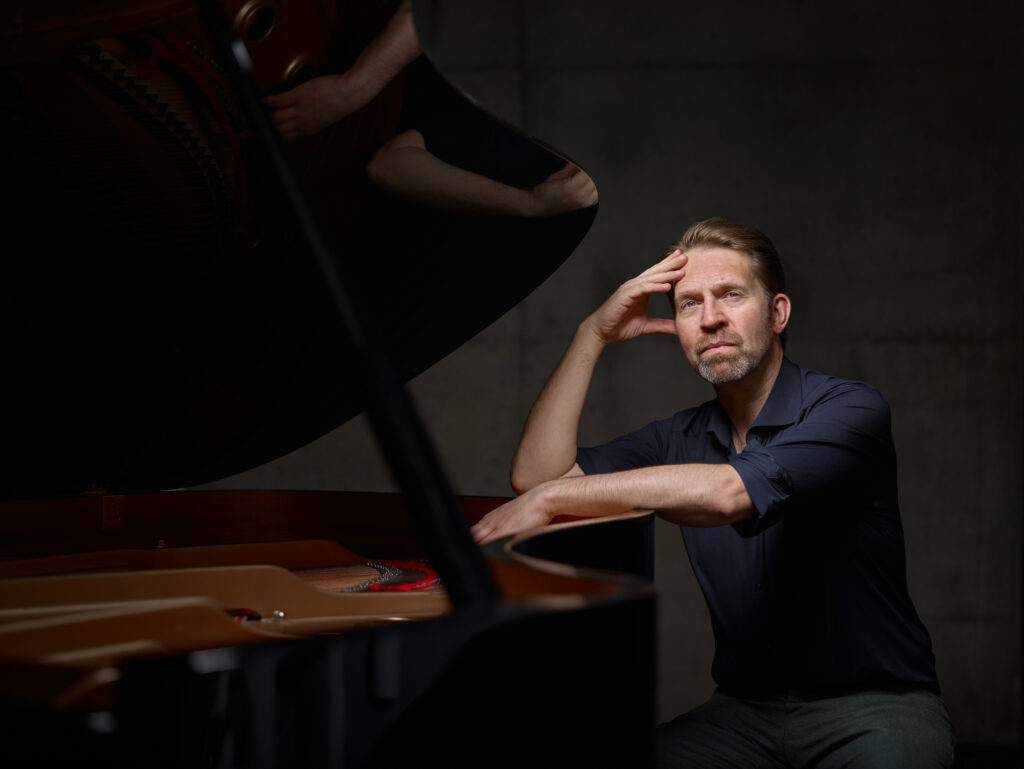
Norwegian piano virtuoso Leif Ove Andsnes began his international concert career in his 20s. He has since performed all over the world while notching up an impressive discography that encompasses solo, chamber, and concerto repertoire. This spring he will release a disc of piano works by fellow Norwegian, Geirr Tveitt.
Listening Room: Leif Ove Andsnes
Share: 


Robert Schumann: Kreisleriana
I was doing a masterclass a couple of weeks ago, and somebody played Schumann’s Kreisleriana. I found myself getting extremely emotional about it. I absolutely adore Schumann; in recent recitals I’ve done Carnaval and Four Piano Pieces but I’ve never actually played Kreisleriana. There’s something so sad and tragic about each movement, real heartbreaking moments, and that just got to me. We know it was one of Schumann’s favorite pieces and of his wife, Clara, who would often play in concert.
So many of his pieces have this combination of the feverish and deeply emotional. It was the same with the Fantasie, his next opus. What an incredible genius he was, and when you think when it was written, in the middle to late 1830s, I mean, we’re just 10 years after Beethoven wrote his last sonata, and when Schubert was composing his last pieces. Up until then everyone had written absolute music: sonatas, preludes. Chopin would go as far as to call his pieces ballades, but nothing more than that. Then along comes Schumann a decade later with such developed pianistic thinking with program music for the piano. He’s writing about a people and fiction, and everything is based on literature and his imagination. It’s just overwhelming. It’s like what Berlioz is doing with the orchestra. Of course, Schumann’s a famous composer, but I don’t think it’s appreciated what an incredible revolutionary and modern thinker he was.
Kreisleriana, Op.16 – Edition Géza Anda, Schumann and Chopin – Audite Musikproduktion
György Kurtág: Stele
I was thinking of somebody who has just turned 100 years old, the Hungarian composer, György Kurtág. He’s been a big part of my life although I only worked with him once in 2010 but I’m always returning to his music and learning new pieces. I’m going to recommend his piece for a large orchestra, I think his only one, called Stele. It’s huge, not in terms of length, because nothing is long by Kurtág as everything is so concentrated, but in terms of resources. I think there are about 110 or something in the orchestra. It’s gigantic, and that’s also a reason why it’s not done so often. But there’s a signature in Kurtág’s music, in the gestures, in the harmonies, that is so distinctive. And listen to the last movement of Stele that has these sort of sobbing qualities, that feeling of loss. This is often found in his piano pieces as well. It just takes him a few seconds to get to one very distinctive character or mood or emotion. It’s a rare quality in a composer and I hope he stays with us for a long time to come.
Stele, Op.33 – Berliner Philharmoniker, Cond. Claudio Abbado – Deutsche Grammophon
W.A. Mozart: String Quintet No.3 in C Major, K515
I’ve only talked about tragic music, so let’s get to Mozart! I was thinking about the string quintets and I have a real soft spot for the C major. I was just listening to the first movement and there’s a kind of magic in the music; it’s like walking into a theatre because it has the same qualities you find in Mozart’s operas.
With a quintet, he has more voices than a quartet to play with and being the virtuoso he was, he creates even more magic, especially in the middle voices with all these subtle moments. Everything is so right.
Mozart: String Quintets K. 515 & 516 – Antoine Tamestit, Quatuor Ébène – Erato
Geirr Tveitt: A Hundred Hardanger Tunes, Suite No. 1
The Norwegian composer, Geirr Tveitt did some wonderful orchestrations of his Folk Tunes from Hardanger. I would recommend the Suite No.1 which is a great introduction to his music. The first piece is called Velkomne med aera – Welcome with Honour – which is a folk tune and one of Tveitt’s most widely known works in Norway. The orchestration is lovely; there’s a harp playing the arpeggio chords and then there’s a bassoon solo and then it just opens up. He had a real ear for colors. I love these pieces. I think they should be played a lot more than they are.
Geirr Tveitt: A Hundred Hardanger Tunes, Suites No. 1 and 4 – Royal National Orchestra of Scotland, Cond. Bjarte Engeset – Naxos
Wilhelm Stenhammar: Serenade in F Major for Orchestra, Op.31
Another piece of Nordic music which I think is a bit underrated is Serenade for Orchestra by the Swedish composer Wilhelm Stenhammar. At his best he’s so refined, and this is a masterpiece! He’s not as wild as Sibelius, but just as original and the Serenade is on the same level as Sibelius. It has a very Scandinavian sound to me. If you listen to the second movement, the Canzonetta, it’s strange how Swedish it sounds, quite melancholy but not tragic… a midsummer night kind of melancholy! It’s quite famous in Sweden, but I think it should travel much, much more.
Stenhammar: Symphony No.2 / Serenade – Gothenburg Symphony Orchestra, Cond. Herbert Blomstedt – BIS Records