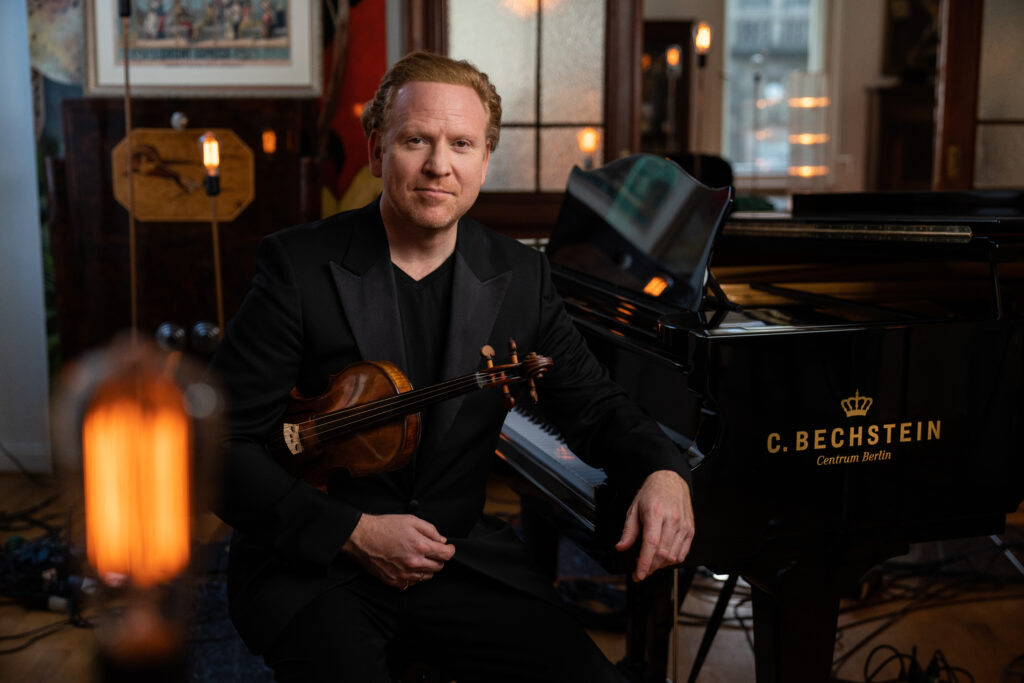
Violin soloist Daniel Hope is one of classical music’s greatest explorers. Never one to shy away from a challenge – musical or otherwise – he has built an eclectic and acclaimed discography. This year he makes his debut as the artistic director of the Menuhin Festival in Gstaad, Switzerland.
Listening Room: Daniel Hope
Share: 


Claude Debussy: Clair de Lune
My first choice is Claude Debussy’s Clair de Lune, played by my dear friend and colleague Menahem Pressler. It was recorded towards the end of his extraordinary life, and every note seems illuminated by wisdom, tenderness, and humanity.
I had the immense privilege of sharing nearly 400 concerts with Menahem during my years with the Beaux Arts Trio. What always moved me most was the generosity in his playing and his soul. Nothing was ever about ego. This recording feels almost like a farewell letter – intimate, fragile, and deeply sincere. Whenever I hear it, I think not only of a great pianist, but one of the most extraordinary human beings I ever knew.
Menahem Pressler, Clair de Lune – DG
Ralph Vaughan Williams: The Lark Ascending
There are many recordings of Vaughan Williams’s The Lark Ascending, but one has always stood apart for me: Pinchas Zukerman with the English Chamber Orchestra conducted by Daniel Barenboim.
I met Zukerman on my 10th birthday at the Gstaad music festival in Switzerland, and he has remained a lifelong friend and inspiration. He once told me the wonderful story behind this recording. Barenboim phoned him one morning in London during a session devoted to English music and said they had finished early and had some extra studio time. “I want you to record The Lark Ascending with me tonight.” The only problem was that Zukerman had never played the piece before. In fact, he barely knew it. “Don’t worry,” Barenboim replied, “I’ll send the music over. You’ll love it.”
Pinchas spent a few hours learning the work, and out of that spontaneous session came, for me, one of the most beautiful recordings ever made. The violin simply seems to float above the orchestra.
Vaughan Williams, The Lark Ascending – Violin, Pinchas Zukerman, English Chamber Orchestra, Cond. Daniel Barenboim – Deutsche Grammophon
Franz Schubert: String Quintet in C major, D.956
Unrequited love is one of the great sources of music, and few composers understood that better than Franz Schubert. Among his greatest achievements is the String Quintet in C major, written during the final year of his life.
For me, the Adagio is one of the most profound slow movements ever composed – music that seems suspended between serenity and despair. The recording I return to most often is by the Melos Quartet with Mstislav Rostropovich. It is also one of the slowest performances ever recorded, but that spaciousness allows the music to breathe in an almost unbearable way. Rostropovich, incidentally, was also a regular guest at the Menuhin Festival in Gstaad over many years and one of the greatest storytellers I ever encountered.
String Quintet – Melos Quartet & Mstislav Rostropovich – Deutsche Grammophon
Sting: Mad About You
My fourth choice is Sting’s Mad About You from The Soul Cages. My friendship with Sting now stretches back more than 25 years, and he remains one of the most original musicians I have ever met.
There is also a deeply personal connection. Sting eventually bought Yehudi Menuhin’s house in Highgate – the house in which I practically grew up while my mother worked for Menuhin. In a strange way, our lives were linked long before we properly knew each other.
Over the years we have collaborated on stage, television, and recordings, and I have always admired the way he moves effortlessly between musical worlds. Mad About You has constantly struck me as one of his most haunting songs – intimate, hypnotic, and timeless.
Sting: The Soul Cages – A&M
Oscar Peterson: Hymn to Freedom
This is a piece forever linked in my mind with one unforgettable moment. In 2003, the Beaux Arts Trio performed at the opening of the Detroit Symphony Orchestra’s new chamber hall in the first half, while Oscar Peterson and Branford Marsalis played the second half. Afterwards Peterson, already in a wheelchair, was brought backstage to meet Menahem Pressler again after many decades.
Menahem bent down beside him and simply said: “You are one of the greatest pianists of our time. I admire and love you.”
To witness these two giants together – each from completely different musical worlds – was profoundly moving. And somehow Hymn to Freedom captures exactly that spirit: dignity, humanity, and hope.
The Oscar Peterson Trio: Night Train – Verve Records
The Menuhin Festival in Gstaad, Switzerland returns from July 16 – September 5 2026