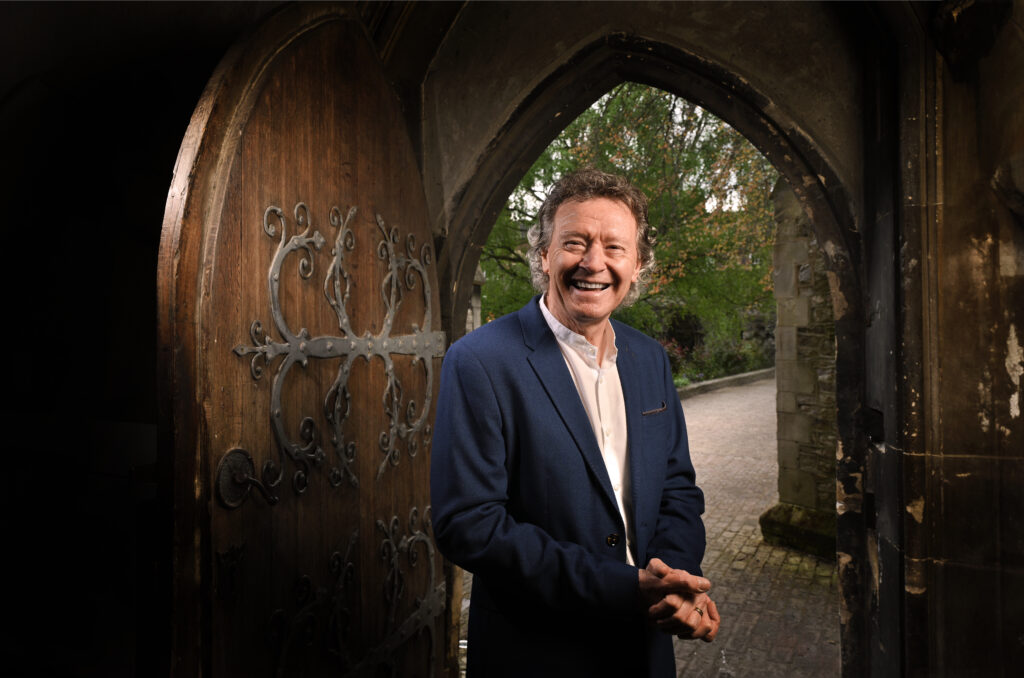
The conductor Harry Christophers has been a familiar presence on both sides of the Atlantic for many decades. For 14 years he was the Artistic Director of Boston’s Handel and Haydn Society while in the UK, he has remained at the helm of The Sixteen, a choral ensemble he founded in 1979.
Listening Room: Harry Christophers
Share: 


John Sheppard: Libera nos, salva nos 1
This is a choral piece that used to be sung at the beginning and end of the day at Magdalen College, Oxford, which is where I was a student.
Sheppard was a stalwart of English renaissance music, a composer who wrote in long note values so the music is relatively still but the imitation is just beautiful. It’s a gem and the choir loves singing it. My tutor at Magdalen, David Wulstan – he was probably Sheppard reincarnated! – edited a lot of Sheppard’s works and brought him to life for modern audiences.
Benjamin Britten: Death in Venice
A lot of my choices of music are through association. When I left Oxford, I sang at Westminster Abbey for six years. The first special service I sang when I was there was for Benjamin Britten’s memorial service in 1977. A few weeks later I went to sing to the conductor Steuart Bedford and the producer Colin Graham, both of whom had worked closely with Britten, and had set up the English Music Theatre company. And here I was, a sort of youngster out of Oxford, and I’d gone in and the first professional opera I ever did was Death in Venice at Covent Garden. In those days the Royal Opera didn’t do much contemporary music so it was deemed the English Music Theatre should perform Death in Venice. It had Peter Pears as Aschenbach, John Shirley- Quirk doing the multiple parts, and James Bowman as the Voice of Apollo. I was third gondolier! I’ll never forget my audition and Steuart Bedford playing Canticle No. 1 for me, you know, this is Britten’s prodigy.
We always say that Britten was the only composer since Purcell who knew how to write for the English language. I mean, it’s his writing of what we might call recitative moments, his complex choral writing, the amazing orchestration in it. For most people, Death in Venice won’t be top of the list, that’s probably Peter Grimes or Billy Budd. But being a tenor and hearing Peter singing, it was just an amazing time to be enveloped in this world of people who knew Britten so well.
Igor Stravinsky: Symphony of Psalms
I was introduced to Symphony of Psalms at Oxford. There was a recording by Simon Preston and the Philip Jones Brass Ensemble and I thought, wow, what a piece. But then I remember hearing Pierre Boulez do it and thinking, blimey. I thought it was a good piece but this is in the hands of somebody who has just got Stravinsky. It was the precision of his conducting, and how he brought out the music’s rhythmic vitality.
I’m always tickled by any of Stravinsky’s pieces because there were all these commissions and he would say, duration, 40 minutes and actually it would only last 20. I just love him for that. I recorded Symphony of Psalms with the BBC Philharmonic. I loved it and dare I say, it has one of the most in tune last chords, and that was a first take!
George Frideric Handel: Saul
Handel has got to be here. Saul is an incredible oratorio. Handel wrote it when he was at his most prolific. His librettist, Charles Jennens, thought he was stark raving bonkers because Handel included this instrument called the carillon, which is basically a glockenspiel. He used it to drive Saul crazy. Saul has killed a few thousand men, but his rival David has killed 10,000 men, and winds Saul up to the sound of this tinkly little instrument.
Thank God, Handel came to England, and thank God he stopped writing Italian opera because we got the bonus of his oratorios which are all opera based. Handel brought his incredible knowledge of opera into his oratorios and that’s why you see today, all these oratorios being staged because they make fantastic pieces of theatre. Handel really knew how to get into his characters. Saul’s orchestration is phenomenal, and you’ve got extended choruses… there’s all sorts of things happening, and the libretto is wonderful.
Gustav Mahler: Symphony No. 9
I’m going with Mahler. I bought Solti’s recording of the 9th Symphony when I was at Oxford. I know people interpret the last movement in so many different ways. I attribute it to hope, because I’m ever hopeful – I’m hopeful Arsenal FC win the Premiership! I love my old Solti recording but there’s also a lovely recording with Simon Rattle and the Berlin Philharmonic which is a goodie because the last movement isn’t over-indulged or extended which tends to happen with some conductors. Simon, I think, gets the right balance; he indulges but also leaves something to the imagination. I don’t know, it’s just such gut-churning music, and to be honest, I don’t play classical music at home, but if it’s a Sunday afternoon and nobody’s about, I’ll stick on some Mahler.