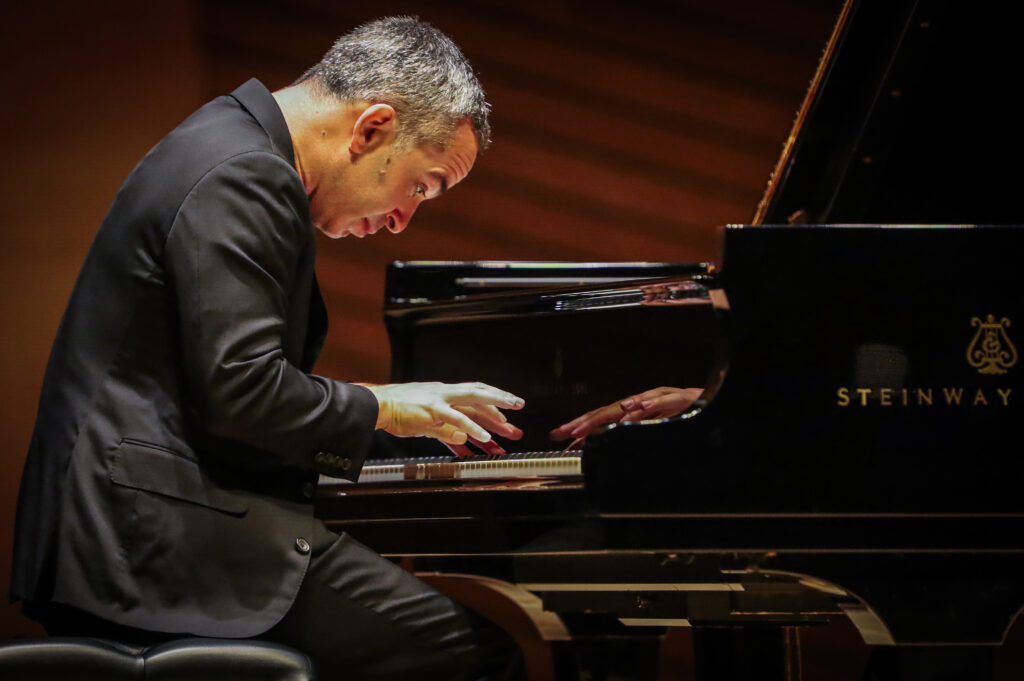
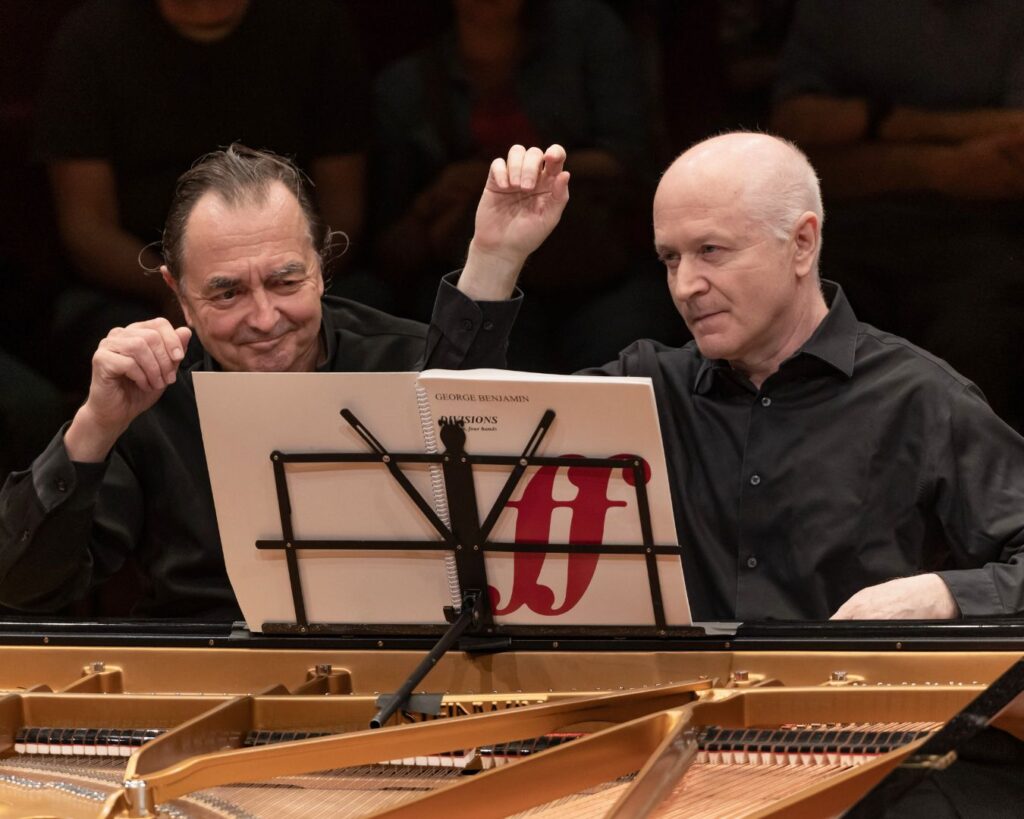
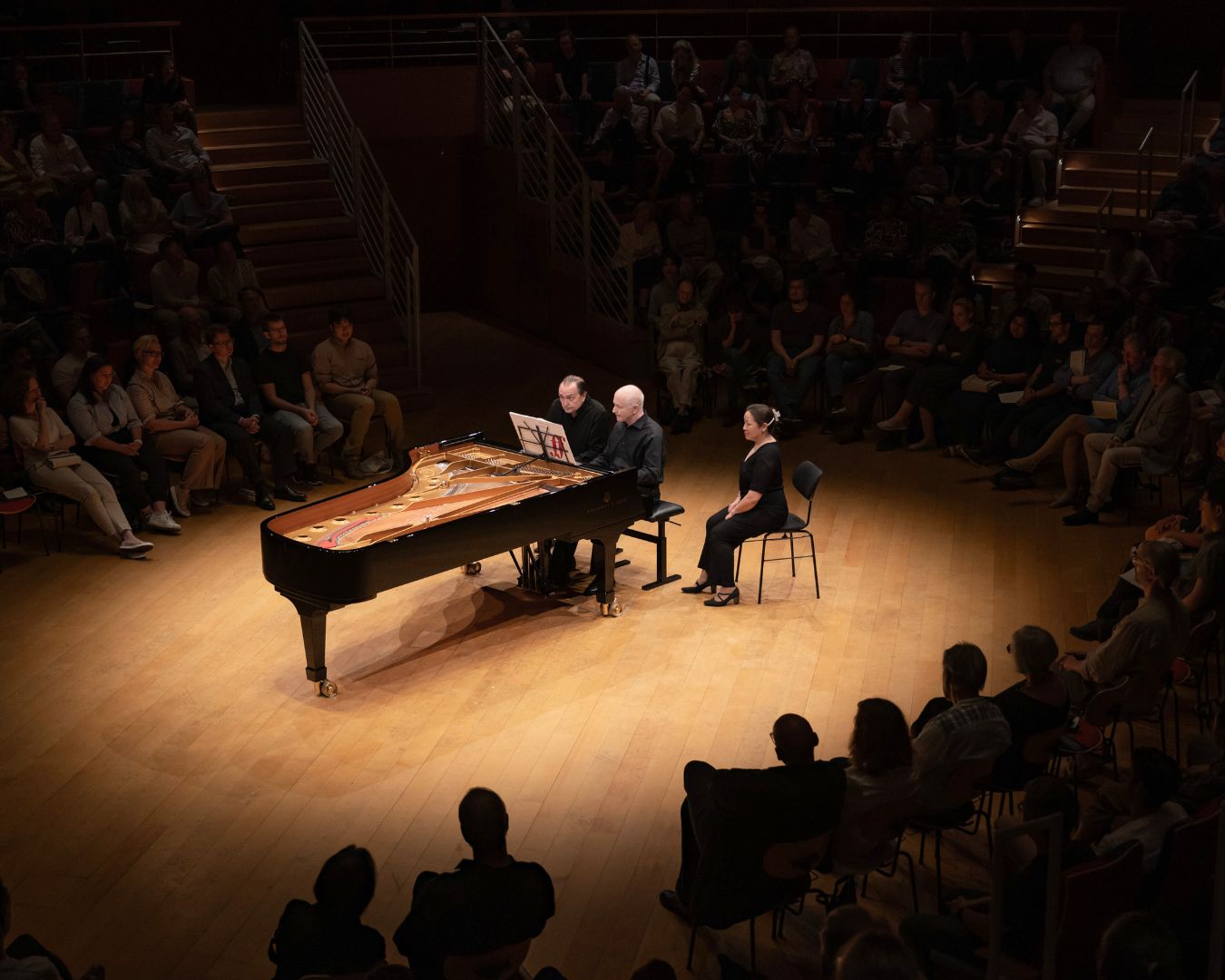
In 2025, British composer Sir George Benjamin premiered Divisions, a 15-minute piano duet for four hands composed for and premiered by his long-time collaborator, French pianist Pierre-Laurent Aimard. Here, the two friends sit down to discuss their decades-long friendship and extraordinary careers.
Stories: Pierre-Laurent Aimard and George Benjamin, Part I
Share: 


GEORGE BENJAMIN:
I had the joy of meeting Olivier Messiaen and his wife, Yvonne Loriod, on April the 15th, 1976. I went with my teacher who had arranged the whole meeting. I played on the piano my baby pieces, and well, I was 16… he was very warm, very encouraging. It was an overwhelming experience to meet a great man like that at such a young age. He invited me to come to the Conservatoire immediately because he only had two more years of teaching. My first year at the Conservatoire was in my last year at school in London. I would come over to Paris for two nights – Tuesday night, Wednesday night – and I would go to his class on Wednesday morning, her class on Wednesday afternoon, and his class on Thursday morning, and then come home. I was allowed to miss two days of school once a month for that whole year.
In one of the earliest classes, Pierre-Laurent was there. We were introduced, and I can sort of remember it. You were, what, 18, so seriously old. Two months later, you joined the new Ensemble Intercontemporain, with Pierre Boulez, so that was a big thing. You were, of course, their star for 20 years.
Then I came to live in Paris for a full year the following year. I left when [Olivier] Messiaen retired. We must have seen each other every now and then. I remember being driven in a little car with you and talking about Hungary. Maybe because you had a Hungarian girlfriend called Segovia, which isn’t a very Hungarian name.
For some reason, I have a memory of us discussing the meaning of life, of which I knew nothing, in the car, in traffic. We did encounter each other over the next six or so years. But my next big memory is in the middle of the ’80s, at IRCAM [the Institute for Research and Coordination in Acoustics/Music, in Paris].
PIERRE-LAURENT AIMARD:
I never went to Paris for long, because I lived in Lyon, so I didn’t meet many people there. But in the case of you, George, the communication was so strong because it was so open, immediate, warm, alive, and interesting. There was something like an explosion of vitality, in the context of a house where it was not necessarily always the case. It was serious in the Conservatoire. In any circumstance, it was more than welcome.
GB:
It can’t have been a complete accident that when Pierre Boulez, in 1983, asked me to come to IRCAM and write a piece – and I spent basically the next three years working there, inventing an instrument and composing the piece – that the central part, the most important part by far, was for you. I remember how involved you were in the project and in the making of the instrument, and how, in a way, excited you were about all the things that were going into it, and how encouraging you were about it. It was written very much with you in mind. So we must have, for some reason, had contact with each other.
Oh! You came to play at my parents’ house. You came to play with the Philharmonia, I think, a Mozart or Beethoven piano concerto, and you came to practice at my parents’ house. That means already that there was a friendship then, because I wouldn’t invite anybody off the street.
PLA:
It was not frequent, because we were living… well, there wasn’t an ocean between us, but there was water. But it was very, very present. So that when our friendship was reactivated at the start of the ’80s, I thought you had changed. I thought, “Oh, he went through maybe some hard moments in his life.” I remember I was in a crisis moment myself. You came to my home at this time.
GB:
Where was it?
PLA:
This tower, on the 24th floor.
GB:
Oh yes, yes. I can remember. That was the destination of the car ride.
PLA:
And it was in indescribable chaos. At the time, I didn’t do a lot. I read mostly on the canopy, apart from when I played in the ensemble.
GB:
So you had a crisis. We all have crises when we’re young, it’s unavoidable, necessary.
PLA:
But the great thing is that we are young all life long. Of course, we have a lot of them.
GB:
When did you live in Belleville? When did you move there?
PLA:
Not easy to say, because, in fact, I had bought a house where it was possible to practice, and the house had been preempted by the town of Paris on the last day of a two months’ delay. In between, I had a very bad notaire, a lawyer, who told me that it was all clear and I should sell my house. I sold it, and this was in ’89, I guess, so that was when the house had been preempted. I had nowhere to live, and I had a wife who arrived from Russia.
“She was a great artist. A really miraculous musician, one of the finest piano players. She started a fantastic career, but she had to stop because of tuberculosis. Maria was one of the gurus.”
GB:
When did you marry?
PLA:
In 1985. But she came from the Soviet Union in 1986. And then Antoine was born in ’87. He was very young when all that happened. So you’re in the middle of winter with a small boy and a freshly arrived Russian wife, and you have no house. It was a bit complicated. Then I could buy something in an old place to be restored. I found a company, but the problem was that the company was not clear at all. They took the money and went away and left just a bit of sand and a couple of pieces of béton (concrete). And it lasted one year and a half until we could live there again, after all possible things.
GB:
In the early ’80s, was the ensemble coming to London from time to time? I think you asked me, “I have to come to London. Could I possibly come into your home and practice the piano?” I think it must have been like that.
PLA:
I don’t know if I would have dared. Okay, I suppose I proposed it very gently.
GB:
And then I must have also come to the concert. What other reasons would we have for meeting in the early ’80s?
PLA:
I came often to London because… was I still studying with Maria Curcio?
GB:
Yes, I remember that name. I remember you were studying with her.
PLA:
Yes, this was not that easy, because flights were expensive, so I took the train, the boat. It meant seven hours in each direction, so 14 hours travel for an hour of lesson, or one hour and a half. She was a great artist. A really miraculous musician, one of the finest piano players. She started a fantastic career, but she had to stop because of tuberculosis. Maria was one of the gurus. She was one of Schnabel’s students; she had this tradition. She was Jewish and Italian, a friend of everybody, and coach of Argerich, Lupu, Giulini; they would call her as an advisor for their concerts. I remember in Paris a rehearsal of Schubert’s Tragic Symphony with Giulini. She was advising everything, she was fantastic, really.
GB:
I was in Paris from time to time. I was at the world premiere of Gérard Grisey’s Modulations, which was in the Théâtre de la Ville in ’77, ’78. During my second year in Paris, I’m sure I saw you at concerts where you played the electric organ. It was a very lively time in French musical life. Not only in terms of concerts and a lively, big, involved audience, but there was Messiaen, Boulez, Dutilleux, Xenakis, Grisey, Murail, etc, living in Paris, working in Paris, and Lutosławski, Berio, Ligeti, Stockhausen, Carter… you name it. People were coming in all the time.
PLA:
Thanks to Boulez.
GB:
Exactly, thanks to Boulez. It was a fantastic, exciting time. Did we see each other much socially when I was working at IRCAM? Because in the years ’83 to ’86, I spent many months in Paris working there. It was immense, the amount of work. So did we see each other for lunch or dinner occasionally or not?
PLA:
This was not the moment when I was in Paris the most, especially at the end, because I got married to Irina [Kataeva]. That had to be prepared and was a lot of work. And afterwards, as she couldn’t come, I lived in Russia for eight months. In Moscow.
GB:
What happened? What happened to Ensemble Intercontemporain during those times when you were living in Russia?
PLA:
I had a light contract, 36 hours a month.
GB:
Could you fly from Russia to Paris, easily, like that?
PLA:
Yes, it was possible. It was the end of Perestroika.
GB:
But we never collaborated musically, did we? You never played one of my baby, early piano pieces.
PLA:
Not the sonata, because there were far too many notes, and I would never be fast enough to learn them.
GB:
You’re completely right. Far too many notes. And Sortilèges, also lots of notes.
PLA:
No, I love Sortilèges. I’ve taught it several times, and I wanted to learn it anyway.
GB:
Too much Messiaen in it.
PLA:
But it’s so distinguished, so fine, and poetically, so touching.
GB:
Oh, that’s very sweet. I’m surprised. I didn’t know that. I’m touched by that. I still think I’m right, though [laughs].
PLA:
I have no doubt about that. I will keep my judgment for a while.
GB:
When did we first do the Ligeti concerto when it was with me conducting? I did a festival with the San Francisco Symphony called Wet Ink, and it was something like 1989 and I spent two months there, and it was lovely. Definitely, you came out. We did the Ligeti, and what else… Antara, didn’t we? But with the click track…
PLA:
I don’t think we did it.
GB:
Yes, we did it with the click track, we made the click track. Terrible, horrible, horrendous, appalling. Should be illegal. We did something else apart from the Ligeti. Did you play some Messiaen or…?
You did some Ligeti studies as well. You were everywhere playing those, because the Ligeti studies, at the end of the ’80s, were hot in the news in the contemporary music world: the great composer who’d never touched the piano suddenly is writing nothing but piano music. And they were all, after the first few, for you. You were the pianist for it. You were playing it across Europe and across the world, playing all these pieces with legendary success and triumph. Did you only play the Ligeti in San Francisco?
PLA:
This is what I remember. But your memory is much better than mine, obviously. We did it a second time in San Francisco years later.
GB:
Yes, yes. We did it in the big hall. We played that piece lots together. Above all, I recall performing it in Berlin with you – with members of the Berlin Philharmonic – in around 2002 and, because of you, Ligeti joined us for all the rehearsals and the concert; he was in fantastic form throughout the week, and that’s a beautiful memory for me. We also played Messiaen’s Oiseaux Exotiques a lot, here and there. And then, of course, I had written this big piece in which he was the center. Antara, an electric, acoustic, computerized piece. There were performances of that here in London, for instance, and we recorded it.
PLA:
But this has not been played often enough, obviously, because of the technology.
GB:
Yes, which is very heavy and complicated and there’s all the pedaling and all the buttons you have to press and all the levers. You did it brilliantly, of course.
PLA:
I love that with Antara, finally, you feel that you are a musician, an executor, a performer, not a pianist, you know. So that’s much more interesting to learn. Every gesture was fun for me.
GB:
The idea was to make it so that you just thought “there’s no electronics in here at all, but what’s being played is impossible.” And to give the freedom of performance. I don’t think I was totally successful, but I did try very, very, very hard. There was a lot of work on that, a lot of work rehearsing alone with you, and there are some very nice photographs of us together from those days when I had lots of hair [laughs].
PLA:
What was very good was when I programmed Antara at the Châtelet.
GB:
That was lovely in a huge hall. That was great. Kent Nagano conducted. Pierre-Laurent has always been an unbelievably loyal friend to me – not only with my keyboard music, but, for instance, much later with the American premiere of my opera Written on Skin at Tanglewood. That was thanks to him.
Then we played Badenweiler together. That was a very grand hotel, run by our dear friend Klaus Lauer, who very sadly is no longer with us. He was an absolute fanatical fan of new music, and a big friend of Pierre Boulez. He invited me for the first time, like 1991 or something, and I went back many times. It was sort of paradise-like, because you’d stay in this beautiful hotel where the food was fabulous, and there’d be an audience of people, 200, 250 staying in the place, and listening, with incredible attention and enthusiasm. We played Visions de l’Amen there.
PLA:
I learned the first part for this occasion. Visions de l’Amen is a piece for two pianos and the part for Messiaen himself was not too hard (he was an organist, a composer). But the other part for his new student, a pianist virtuoso, really? Oh my gosh.
GB:
Any other places we collaborated like that? I remember we had a wonderful, expensive meal in Lyon together. Your hometown. Léon de Lyon was the restaurant. We had a great, great meal. Why were we in Lyon?
PLA:
Because you conducted.
GB:
I did conduct the Opera Orchestra there. Yes, contemporary music.
PLA:
And I visited my parents.
GB:
I knew your parents well by this time. We did see quite a lot of each other. And then by the middle of the ’90s and into this century, then we were working lots together. Half of the concerts that I conducted, which has never been a huge amount – because I need to compose – would be with Pierre-Laurent playing. And over the years, we’ve done both Ravel concertos together, the left hand several times.
PLA:
But what was very strong was Duet.
GB:
I was invited to write a Roche commission for the 2008 Lucerne Festival. It was played here at Carnegie Hall, with Shostakovich’s Seventh Symphony afterwards…
PLA:
Wait, I have a story then…
GB:
With Elliott?
PLA:
Yes, I told you already.
GB:
Please say it [laughs].
PLA:
Well, it was so funny. Your duet is an anti-concerto, the least demonstrative piece possible, intentionally. And 13 minutes, right?
GB:
12.
“He was a real admirer of your music. I can tell you because I spoke with him in his late years about the music that he really respected and loved and admired, and like many others, he didn’t know what exactly to reply.”
PLA:
And the second part of the program, the immense Shostakovich symphony, and all the points of view that go with it, gestures that are indescribable. We were on tour with the Cleveland Orchestra and Franz Welser-Möst, and I played in the first part. But can you imagine going on tour for these 13 very concentrated minutes, where very often I just played with my second finger.
GB:
It’s true, the first five minutes, that’s almost all you do.
PLA:
And then the second half. What do you do, especially if you have personal problems with Shostakovich? But I’m very friendly and polite, so I always listen to the second part. To the orchestra and the conductor I’ve shared a partnership with. And in this case, I didn’t know what to do. But by chance, Elliott Carter was at this concert. He was a real admirer of your music. I can tell you because I spoke with him in his late years about the music that he really respected and loved and admired, and like many others, he didn’t know what exactly to reply. He thought that the level of commercial demagogy in the compositions was already frightening. He did not have many names, but you were always there.
GB:
I first met him in London when I was 18, and I saw him many times here in New York, and elsewhere. I was tremendously fond of both him and his wife. A marvelous man, such an incredible mind, but he was also charming, funny, kind…
PLA:
The lightness and the intensity.
GB:
Yes, yes.
PLA:
So… then he comes at the break, blah, blah, blah, and after somebody comes to pick him up, and then he says, “Oh, but I’m so happy to speak with my friend Pierre-Laurent. We have not finished the conversation.” But they say, “We have to go now, Mr. Carter, otherwise you will miss the performance.” And he says, “I’m afraid I think we must have a serious conversation. Could you please leave me here?” And then the person goes out. He would not have been rude enough to tell the truth to the person who came, he was very gentle. And then he said to me, “I’m happy to speak more with you, Pierre-Laurent, but I’m so relieved not to have to listen to Shostakovich.”
GB:
I was good. I had to be, but afterwards I went backstage, and there you were, the two of you just talking, having talked, I assume, for an hour and a quarter.
PLA:
The performance was impressive. I’ve been told.
GB:
It’s a magnificent orchestra with a superb conductor. So… before then, I wrote Shadowlines. It just came to me. It was commissioned after it was finished by my dear, dear friend, Betty Freeman, who I was with here in New York and in California and all over the place. You and I were both immeasurably fond of this wonderful woman. And it was obvious that you should premiere it. That was in London with the LSO’s festival of my music, By George. It was the second world premiere of my work. Boulez conducted the Palimpsests world premiere on the first night and later in the season, in a really nice concert, which maybe had Oiseaux Exotiques; you didn’t just play Shadowlines…
PLA:
Is it true that you interrupted the composition? Because you were facing problems that you couldn’t solve at the moment. And Shadowlines was a way to learn how to solve this problem, to deal with this technique.
GB:
Yes, and I finished Shadowlines in 2001 and the premiere had to wait 18 months or two years.
PLA:
I think this is important to know, because I doubt that you would have composed such a piano piece if you were not in this compositional interrogation.
GB:
Probably, yes, and it was a technical investigation, and the technique that I found myself using was a complete surprise to me. I think that’s never happened in that way, so simple, so clearly. I just sort of started one page, and then thought, this is interesting, and I kept at it and then the next page and the next movement, and why not this, and why not this? And then do that and then try that. The whole process of writing, it was like a journey of discovery for me, and one which I’ve really enjoyed very much, because it was extremely strict. Extremely limiting.
PLA:
Well, there are not so many pieces, not only from you but in general, that are so systemic.
GB:
But my desire was to avoid it sounding systematic or strict, and that was the challenge. It’s a paradox, the piece. It sounds free, even improvisatory, a lot of the time, though that’s absolutely not the case.
PLA:
It makes it one of the hardest pieces to interpret.
GB:
Yes, I know. It doesn’t sound very virtuosic, but it’s also very difficult for the fingers, so the fact that anybody plays it, let alone you my friend, is something of a miracle. And Duet. We did quite a few. We did it in Paris. We did it in Aldeburgh with the Ravel.
PLA:
Yes, with the Mahler Chamber Orchestra.
GB:
Yes, in Aix.
PLA:
We did it on tour… I can’t remember… Berlin, Hamburg and Frankfurt, something like that, with the Mahler Chamber. There were three concerts, and at the end we were three pianists, one for each of the concerts.
GB:
That was the Ravel, right hand. That’s when my Concerto for Orchestra premiered. And you did play London. No, no, not right hand. The Ravel, both hands [laughs]. And what else…
We did the Murail concerto in Munich. We did the European premiere. Was it the world premiere?
PLA:
Yes, absolutely. It was the world premiere.
GB:
Are you sure!?
PLA:
I am sure, because I had wished to have this commission, and I wished to have you as a conductor, and I got both.
GB:
Oh, that’s really nice. And what else, what else…
When you were director of the wonderful Aldeburgh Festival in the UK, both in 2010 and 2015, I had a residency there and we did lots together. And I heard you play amazing concerts there. What you did there was incredible, almost unbelievable. That was fantastic. But we’re leaving lots out, because there’s plenty of times when you would have a concert in London, and I would just go to it, or when you came to visit me at home.
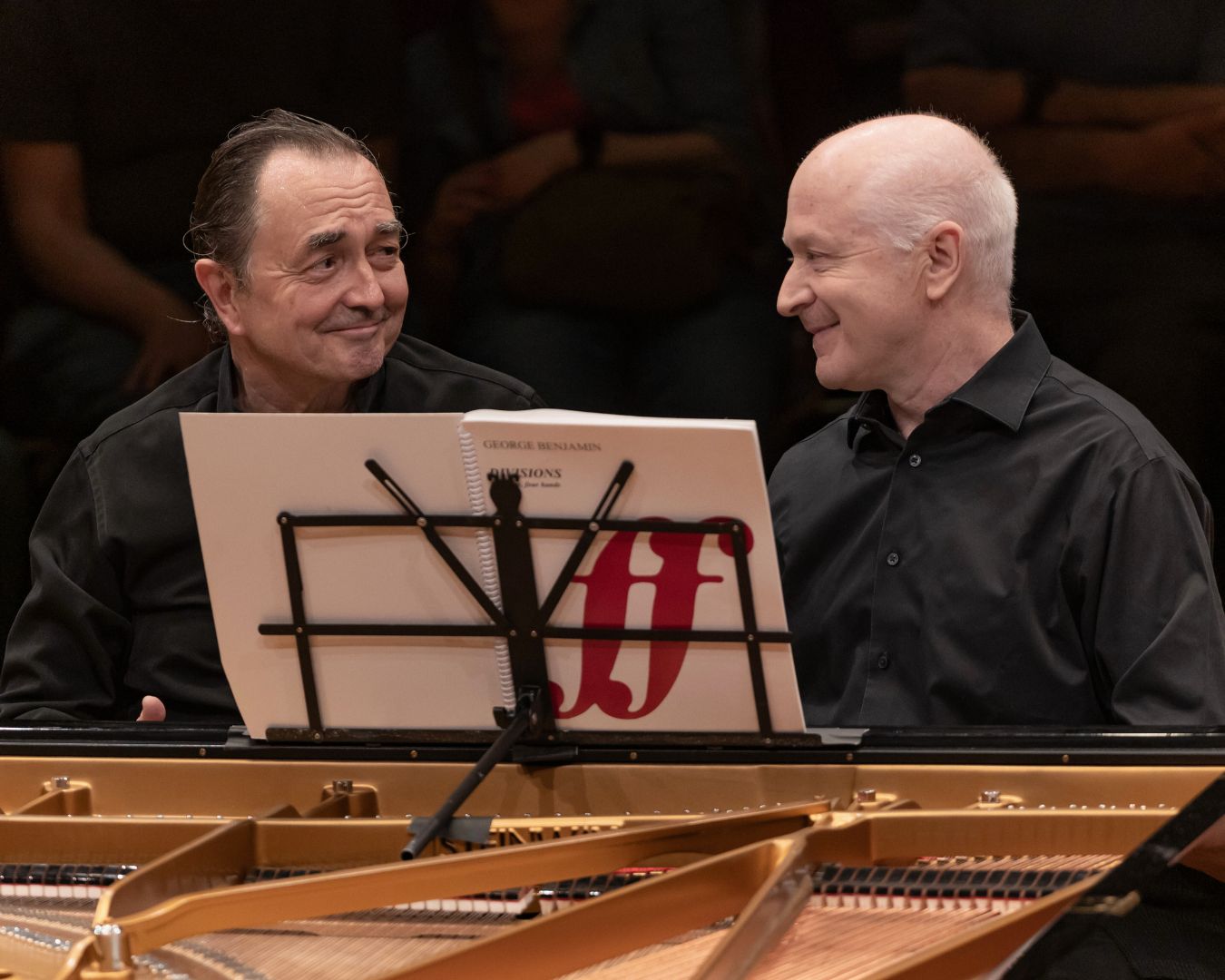
This thing we’re doing now, Divisions, it’s very nice after having this friendship going back so long, because it’s really opening a new door. It was only going to be three performances, but I’ve changed my mind, because I’ve enjoyed it so much. You came to my home twice in June for us to practice the piece, and already, from the first time, I wasn’t expecting it, but you persuaded me… it was your idea that I should play the other part. It wasn’t my idea. That was before I started writing it. When I had written it, and when we started rehearsing, it was just so enjoyable. Firstly, I love playing four hands. It’s just so lovely, such a lovely thing to do. It’s the friendliest form of music making imaginable. But then also the piece itself, particularly as you’ve got so many more notes than me, I can just stand back and watch half of the time and listen. But then again, stuff happens between us. There’s a sort of drama, and we’ll be laughing all the time.
PLA:
So there will be more than three performances. And what about the piece? What piece shall we get? Three pieces or more?
GB:
I want to write more, yes, but I don’t know when or what [laughs]. When I do one thing, I normally say, “I’m not doing that again,” because it’s very good not to repeat oneself. Always good to move on, to go somewhere new. But I had such a lovely experience playing this piece, and also, I suppose writing it some of the time, not all of the time.
PLA:
If I may… Is it true that the four hand pieces are missing nowadays? What about the six hands or the eight hands?
GB:
For that, you need four pianists. And that’s too many pianists [laughs.] Four hands, I like the fact that it’s been ignored. It’s been sort of almost deleted for ever. No one writes for it, really. As a domestic medium, it’s gone. I don’t agree. I think it’s got tons of stuff that you could do with it. I like both the humor and the sort of danger of the theatrical situation. Sometimes in this piece, you’re playing very loud notes bang in the middle of my own fingers, while I’m playing very softly. If my finger had slipped a little bit to the left, it could be dangerous. So there’s both humor and danger in the situation, which is really intriguing.
PLA:
I didn’t tell you: I’ve contracted finger insurance for this piece [laughs]. But you know the four hand pieces of Kurtág?
GB:
No, I don’t know those. And we’re not only talking about Bach transcriptions, we’re talking about pieces?
PLA:
No, no. He wrote beautiful pieces for him and Márta, his wife. But there are two volumes. Some of them are beautiful. And what’s interesting, some of them from the start, when he started to do that, are with several layers of music and time. You have different music floating around, each of them with its fantasy sonority and phrasing and tempo, and then combining and floating together. It’s beautiful.
GB:
He would play those in concerts with Márta?
PLA:
Yes. That was really something incredible. There was a level of fusion and of intensity, of music making and of assumed, shown intimacy that was amazing. In the end, they did a lot of concerts with only an upright piano… I’ve heard recitals from both of them in the Paris Opera, in the Palais Garnier, so almost 2,000 seats. This was something very special, the way he developed the intimacy. There’s a lot of humor in them as well.
You know, this is an anecdote again. I was visiting Kurtág last year when I did the recording, when we were listening to the editing. And then every evening, I had dinner in his studio and we spoke. He asked about different people. I told him about a common friend. I had just had a kind of problem with this friend, a kind of, how do you say, explosion…
GB:
…you had an argument with this friend?
PLA:
Yes, exactly. The friend was a pianist. The day after the argument, Kurtág had composed a small piece for four hands, for this friend and me. We would start each of us, one in the low register, one in the high register. Little by little, he brings us together at the end. And we’d play like that.
GB:
There’s never a more extended movement written for duet by him?
PLA:
No, no.
GB:
Little messages, little cards.
PLA:
Yes, yes.
GB:
Have you recorded those?
PLA:
Solo things only. I would love to do that as well, yes, but there are marvelous recordings of him and Márta. We don’t need anything more.
The conversation continues in Part 2; fabermusic.com